Residential pizza ovens for backyards and outdoor kitchens — specified with you, on display at our Huntington Beach showroom, and delivered across Southern California.
BellaFina Outdoors is a design center for outdoor living in Huntington Beach. A pizza oven is rarely a standalone purchase — it sits in a kitchen run, against a veneer, under something, with a gas line or a wood store nearby. Those details decide which oven fits.
Ovens, stone and tile, outdoor kitchens and shade structures sit under one roof in Huntington Beach — so the kitchen run can be planned together rather than ordered piece by piece from separate suppliers.
Compare size, build quality and working height in person — what a spec sheet cannot tell you: how deep the deck really is, how the door reads at counter height, and how much oven the run can carry.
The conversation starts with your space and how you cook, not with a product page. That often means a shorter list than you expected — the oven that suits the site and the way you actually use it.
Safe spacing, the chimney route and how much weight the base has to carry, all taken from the manufacturer before the enclosure is poured — with one point of contact for the oven, the surround and the stone around it.
Some of the brands we work with






A grill is something the host disappears to. A pizza oven works the other way — it cooks fast enough that people stay beside it, stretch their own dough, watch a pizza go in and eat it standing up. That is most of the reason to buy one.
It also does something an indoor kitchen cannot. The floor temperature a dedicated oven reaches is what produces a cooked base and a leopard-spotted crust; a domestic oven does not get there. When the pizzas are finished, the retained heat is still good for bread, roasted vegetables, whole fish or a slow-cooked shoulder.
The oven that gets used every other week is the one that heats fast enough for a weeknight. Everything else is a party appliance.
Which is why the first question we ask is how often you expect to cook. That answer points to a fuel, a size and an installation type faster than any spec sheet does.
The argument for gas is frequency. It reaches cooking temperature quickly, holds it without anyone tending a fire, and shuts off when you are done — which is what turns a pizza oven from a weekend event into a weeknight one. Temperature control is steady enough that the first pizza and the tenth come out the same.
Gas ovens are also easier to build into a kitchen run, since they run off the same gas line as the grill, and the chimney is simpler than a wood-fired oven needs.
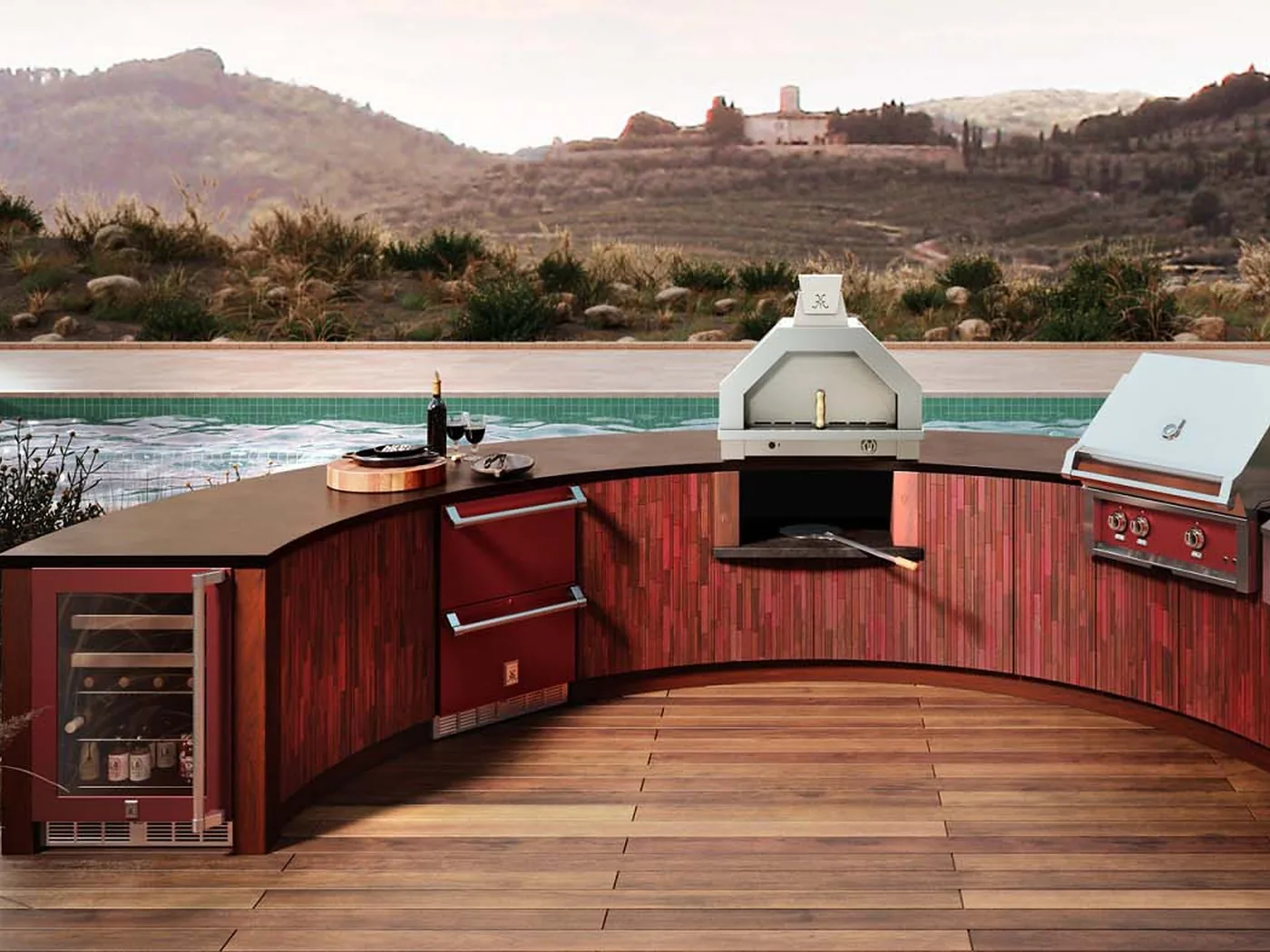
A wood-fired oven asks more of you and gives back something gas cannot: the smell, the flame licking the dome, and a smoke character that carries into everything cooked after the pizzas are done. Building and managing the fire is the appeal for the people who want one, and a chore for the people who don't.
Heavier masonry ovens take longer to come up to temperature but hold heat for hours afterward, which suits a long evening that starts with pizza and finishes with bread. The practical items are somewhere to keep the wood, where the chimney runs, and where the smoke ends up relative to windows and neighbors.
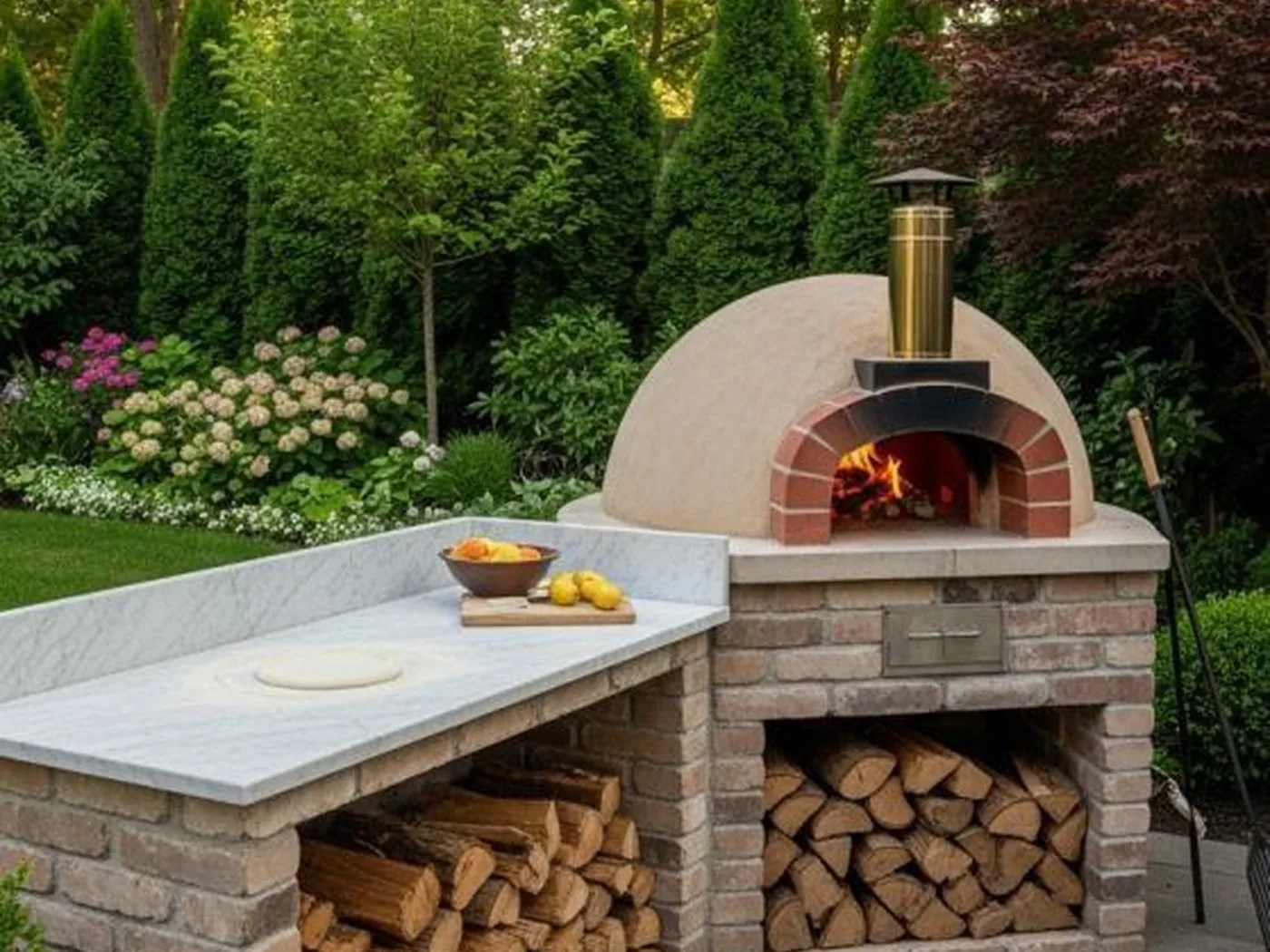
Two decisions cover most of the ground: how the oven is installed, and what it burns. Safe spacing, the chimney and where the oven can sit all follow from those two.
Ovens that drop into an island or masonry enclosure and read as part of the outdoor kitchen run.
See Built-In Ovens →Move-in-ready ovens on a stand or cart — no construction, no trenching, and they can come with you.
Browse Freestanding →Fast heat-up and steady temperature, on the same gas supply that already feeds the grill.
See Gas Ovens →Live fire and smoke character, with dual-fuel models for wood at the weekend and gas mid-week.
Explore Wood-Fired →Planned into the run from the start, so the opening, the safe spacing and the chimney are designed in rather than cut in later.
See Outdoor Kitchens →The weight-bearing base, the surround and the chimney a built-in oven needs, specified alongside it.
Plan an Enclosure →The stone, tile and finish that wrap the oven surround — selected in the same pass as the hardscape.
Browse Stone & Tile →Tell us where the oven would sit and how often you would realistically use it. We will tell you which direction makes sense, including when the answer is the cheaper oven.
Request My Free Quote →Three steps, and the first one takes about five minutes of your time.
Fill in the short form with where the oven would go and how often you would use it. That is all we need to start. If photos of the patio would help, we will ask for them by text or email once we reply — nothing to upload here.
We match the oven to the fuel supply and the space, then pull together the safe spacing, chimney and base-strength figures your contractor needs. Going into a kitchen run, the surround and veneer are selected in the same pass as the rest of the stone and tile.
The oven arrives on your build schedule with the accessories that make it usable on day one — peel, brush, stone and cover. With the specifications settled up front, your contractor has what they need to keep moving.
Six concrete differences, all of them about the decisions that are expensive to get wrong.
We ask how often you will actually cook before recommending wood. If gas is the oven you will use, we say so.
How far the oven must sit from anything that can burn, where the smoke goes and how much weight the base carries all come from the manufacturer's documents, not an estimate made on site.
Roofs, pergolas and tight property lines change what is practical. We work that out at design stage rather than after the surround is built.
Enclosure, veneer, coping and tile selected alongside the oven, so the finish matches the rest of the hardscape.
Size, build quality and working height are hard to judge from a photo. Displays are available for viewing in Huntington Beach.
Orange County, Los Angeles County and San Diego County, scheduled around your build calendar rather than ours.
Five questions decide which oven suits your backyard. Answer them before anything gets built and the rest is straightforward — we can walk you through all five in one conversation.
Gas gets to temperature in a fraction of the time and holds it without tending, which in practice means you use it on a Tuesday and not just at a planned party. Wood gives you live fire, the smoke character and the ritual, at the cost of a longer heat-up and a fire to manage while you cook. Dual-fuel models split the difference. Be honest about how often you will cook: the oven you use most is the one worth buying.
Built-in drops into an island and becomes part of the run — it looks integrated and sits at a comfortable working height, but it needs its opening, safe spacing and gas line designed in from the start. Freestanding arrives on a cart or stand, needs no construction, and moves with you. If the kitchen is being built anyway, go built-in; if the patio is already finished, freestanding is far less disruptive.
Neapolitan-style pizza is generally cooked at very high floor temperatures, which is why a dedicated oven produces a result a domestic kitchen oven cannot. Heat-up time varies enormously by design: compact gas ovens reach cooking temperature quickly, while heavier masonry ovens take considerably longer but hold heat far better afterward. Manufacturers publish figures for each model, and we can compare them against how you plan to cook.
Sometimes, but it is more involved than swapping a grill. A built-in oven needs a base strong enough to carry it, the manufacturer's safe distance from anything that can burn, somewhere for the smoke to go, and a gas line if it runs on gas — and a wood-fired one adds a chimney that has to vent somewhere safe. Retrofitting into an existing island usually means opening up part of the run. Where that is impractical, a countertop or freestanding model gets you cooking without the construction.
Every oven has a chimney or vent set by its manufacturer, and the smoke has to leave safely — which is a live question when the oven sits under a solid roof, a pergola or a covered patio. Wood-fired ovens produce far more smoke and need more thought about where the chimney runs and where that smoke ends up relative to windows and neighboring properties. Settle this at design stage; it is not a finish detail.
The range is broad. A compact freestanding gas oven is a single purchase. A built-in oven in a custom masonry enclosure adds the base, the veneer, the chimney, the gas work and the labor, and lands considerably higher. Tell us whether you are leaning built-in or freestanding, gas or wood, and we can give you a realistic figure to plan against.
From the Huntington Beach showroom we supply and support built-in and freestanding pizza ovens throughout Orange County — for homeowners building one backyard and for contractors building many.
Building elsewhere in Orange County, or just over the line in Los Angeles, Riverside or San Diego county? Ask us — we ship and deliver beyond this list.
Oven size, build quality, working height and how a surround finish actually looks are hard to judge from a product photo. Displays are available for viewing at our Huntington Beach location, so you can compare models in person and talk them through with our team.
We work with landscape contractors, builders and designers across Southern California. The useful part is usually not the pricing — it is having the clearance, flue and base-loading numbers in hand before the island is built.
A freestanding oven on a finished patio, or a built-in oven in a new kitchen run — send us the space and we will work out which one suits it.
Or call (714) 699-9269. We typically respond within one business day.
Tell us where the oven is going and how you like to cook. Our team will follow up with options and pricing, usually within one business day.